Teams typically don’t overspend on dedicated inference because GPUs are inherently costly. They overspend on it because they reserve GPUs before they can keep them busy. An endpoint with low effective utilization could have a higher cost per successful inference than serverless inference even at “large” monthly volumes.
That’s the central mistake in the serverless-versus-dedicated argument: Teams compare token costs with GPU-hour costs without considering utilization, idle periods, retries, or tail latency. Monthly token volume alone doesn’t decide if dedicated hardware is economical. Traffic shape and effective GPU utilization do.
Teams should approach dedicated inference as a performance optimization proven by production traffic not as the default destination for every scaling AI application. Begin with serverless inference while workload behavior remains uncertain. Shift to dedicated resources when predictable utilization, custom-model needs, or service objectives justify paying to reserve GPUs.
The argument point described applies to any provider, but the implementation details still matter. DigitalOcean, Together AI, Fireworks AI, Modal, and others all have different custom-model restrictions, scaling controls, billing units, and cold-start tradeoffs. Those mechanics can change where the break-even point falls, but they do not change the underlying principle: idle accelerators destroy the economics of dedicated inference.
The Dedicated Inference Problem
Reserved capacity solutions feel like a natural upgrade from shared inference. They offer predictable performance, fewer shared-fleet restrictions, stable model versions, and private weight support. All those advantages are real. The mistake lies in thinking that higher traffic means dedicated inference is cheaper.
A workload that processes hundreds of millions of tokens/month can still inefficiently use a dedicated GPU. Workloads may experience bursty requests that vanish overnight. Traffic might vary wildly by day. GPUs can sit idle waiting between sequential agent steps. The monthly aggregate conceals those idle periods.
The question to ask isn’t:
“How many tokens per month will we process?”
It is:
“For what percentage of paid GPU time are we completing useful inference work at an acceptable service level?”
If the answer is only a small fraction, your organization may be paying many times the fully utilized infrastructure costs per unit of useful work performed. Autoscaling can help reduce this waste, but only if the workload has idle windows long enough to scale down and can tolerate the delay required to restore capacity.
Why Start With Serverless
A serverless inference endpoint is a managed API that applications use to submit inference requests without provisioning GPU instances.
The provider is responsible for:
- GPU fleet
- Loaded, supported models
- Request routing
- Request batching (compatible requests)
- Scaling shared capacity
- Inference software updates
- Platform-level security and monitoring
- Replacing failed infrastructure
Serverless usage is commonly billed per million input and output tokens. Some platforms charge embeddings, cached tokens, image generations, audio, or reasoning tokens separately. Serverless doesn’t actually mean there aren’t any servers. There are still servers and GPUs. The key difference is that customers don’t reserve or control those resources.
This abstraction transfers utilization risk to the provider. When there’s no traffic for your application, you typically aren’t charged for idle GPUs.
Serverless inference is thus not simply a prototyping product. Workloads that are large over time but intermittent can continue to find serverless the better production option. Virtual assistants within larger organizations, document-processing applications, batched reporting processes, and new features in established SaaS applications are some examples of workloads that fit this description.
DigitalOcean Serverless Inference lets you run supported models from its managed Model Catalog. As with the serverless products from Together AI and Fireworks AI, you trade some model and infrastructure flexibility for pay-as-you-go access to a managed shared infrastructure. The constraint is model support. Serverless catalog is a managed infrastructure. You can’t host arbitrary models there. If the app needs a private checkpoint, a modified tokenizer, an unsupported architecture, a custom CUDA kernel, or special quantization, the shared service may not support it.
What is a dedicated inference endpoint?
A dedicated endpoint hosts a model running on GPU resources reserved for a specific customer or deployment. Other customers do not send requests to the reserved deployment.
Managed dedicated endpoints should not be mistaken for fully self-hosted inference. With a managed endpoint, the provider may still manage the cluster, networking, storage, container runtime, inference engine, monitoring, and restarting failed nodes. The customer gains infrastructure isolation and greater configuration control without having to take responsibility for all layers of operations.
DigitalOcean’s Dedicated Inference, for instance, manages model storage, vLLM serving, ingress networking, autoscaling infrastructure, routing, parallelism, and more multi-node serving logic. Customers choose their GPU resources and replica counts while the platform abstracts away much of the deployment stack.
When Custom Weights Make Dedicated Inference Worth It
You can check your model and deployment requirements against DigitalOcean support before even considering latency or cost. By “Custom model,” we can mean many things:
- A prompt or system instruction applied to an existing foundation model.
- A provider-trained fine-tune
- A LoRA or another parameter-efficient adapter
- A complete fine-tuned checkpoint
- A custom quantization of an existing architecture
- A model with a modified tokenizer
- A new model architecture
- A model requiring custom kernels or inference code
In the first case, you likely don’t need a custom deployment. You can create a DigitalOcean Serverless Inference endpoint that accepts your prompts, system instructions, tool definitions, and application-side logic using any supported model from the DigitalOcean Model Catalog.
The other scenarios may require DigitalOcean Dedicated Inference. DigitalOcean’s Bring Your Own Model, or BYOM, feature lets you import supported private or fine-tuned models hosted on Hugging Face or in a DigitalOcean Spaces bucket. BYOM models can currently be deployed using Dedicated Inference, not Serverless Inference.
DigitalOcean checks the architecture, license, config, tokenizer files, format, and dependencies of imported models to confirm they are compatible.
Below, we provide a comparison of DigitalOcean’s, Together AI’s, Fireworks AI’s, and Modal’s support for custom-model inference. This includes their approach to model deployment, managed serving abilities, model limitations, and cold-start trade-offs when utilizing dedicated GPU capacity.
| Provider | Custom-model deployment | Serving approach | Important limitation or trade-off |
|---|---|---|---|
| DigitalOcean | Bring Your Own Model (BYOM) accepts Safetensors weights for architectures compatible with DigitalOcean Dedicated Inference. | Manages vLLM serving, ingress, model storage, autoscaling components, prefix-aware routing, parallelism, and multi-node infrastructure. | Unsupported architectures, custom serving code, or unavailable kernels can cause model validation to fail. Customers must also generate enough work to justify reserved GPU capacity. |
| Together AI | Supported fine-tuned models are served through Dedicated Model Inference . | Provides managed dedicated endpoints with configurable autoscaling, hardware, replica bounds, and serving controls. | Deployment depends on the provider’s supported models and import requirements. Running dedicated replicas can incur costs during underutilized periods. |
| Fireworks AI | Uploaded models and fine-tuned LoRA models require on-demand dedicated deployments. | Provides on-demand GPU deployments with configurable hardware, autoscaling, regions, and serving controls. | Private models cannot simply be deployed through the serverless model catalog. Scaling to zero can also introduce cold-start delays. |
| Modal | Developers define GPU-backed functions, containers, and model-serving environments in code. | Workloads can scale to zero, while developers retain substantial control over runtime resources and serving configuration. | Large-model initialization may take minutes. Keeping a minimum number of warm containers reduces cold-start exposure but reintroduces idle compute costs. |
DigitalOcean provides a managed path from catalog models to supported private weights via Dedicated Inference. Once deployed, private models are operationally accessible and automatically economical. Customers are responsible for maintaining sufficiently productive GPU utilization to justify reserved capacity.
An Example Based on Assumptions
The example below is illustrative; it is not a measured benchmark. Provider prices are confirmed with published provider documentation as of August 25, 2026, and are subject to change. As of this writing, DigitalOcean charges $4.41 per GPU-hour for one NVIDIA H100 on Dedicated Inference.
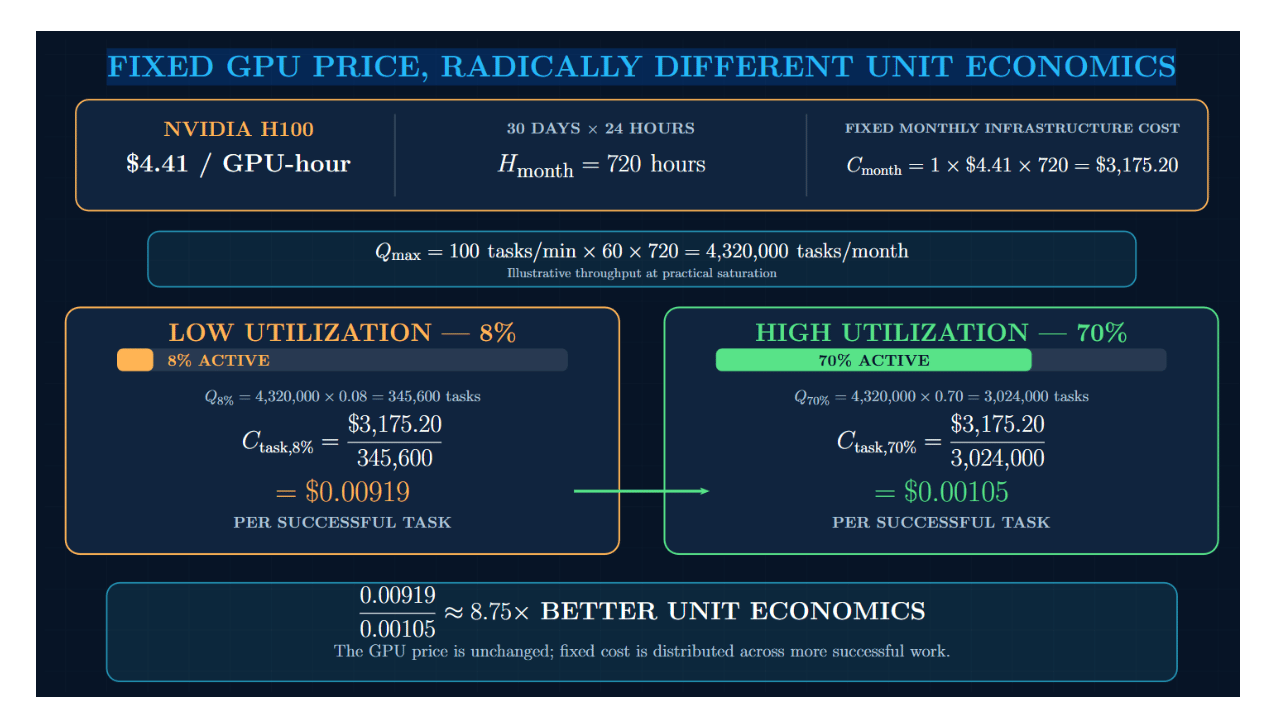
Leaving one H100 running constantly for a 30-day month incurs an infrastructure cost of about: 1×$4.41×720=$3,175.20. Assume that the endpoint can produce 100 successfully completed tasks per minute at practical saturation, with a workload of the benchmarked size. That endpoint has a theoretical monthly capacity of 100×60×720 = 4,320,000 tasks.
If effective utilization is 8%, the deployment can be expected to complete 4,320,000 × 0.08 = 345,600 tasks. Assuming that storage and network costs are negligible, its dedicated inference cost would therefore be: 345,600/$3,175.20 = $0.00919 per successful task.
At 70% utilization, the same endpoint completes 3,024,000 successful tasks, reducing infrastructure costs to $0.00105 per successful task. The GPU price did not change. The useful economics improved by approximately 8.75× because the fixed cost was distributed across far more successful work.
That’s why comparing providers only on the GPU-hour rate is insufficient. DigitalOcean’s listed rate for an H100 is $4.41 per hour, while Together AI lists theirs at $5.49 per hour for a single H100 replica. Fireworks bills on-demand deployments by GPU-second and makes available different deployment shapes. Price differences due to billing granularity obviously matter; however, utilization can overwhelm small differences in unit price. An underused $4.41/hour GPU can cost more per result than a heavily utilized $5.49/hour GPU—or than serverless inference on either platform.
The correct comparison is therefore not “tokens versus GPU hours.” It is serverless cost per successful task versus dedicated cost per successful task at the utilization the application can actually sustain.
Compare the economics using utilization
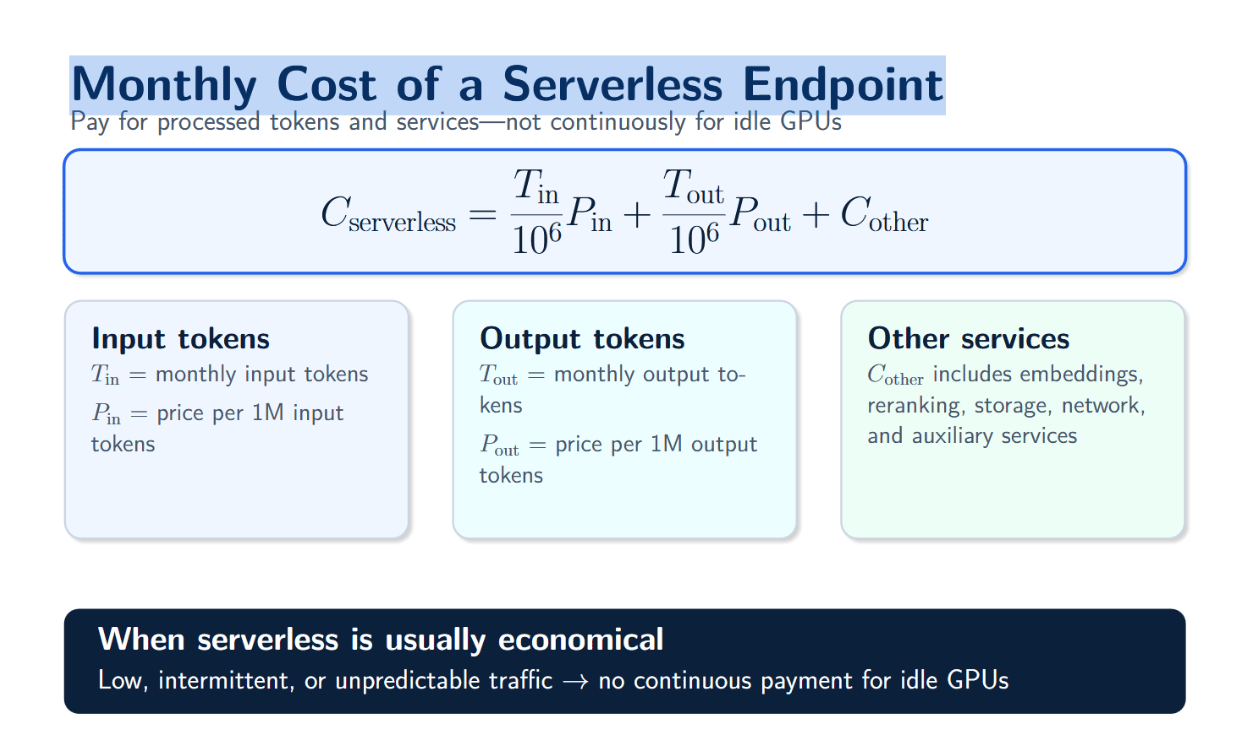
Serverless and dedicated endpoints use different billing units, so comparing their advertised prices directly can be misleading. Serverless inference is typically billed by token consumption, while dedicated inference is billed by allocated GPU time.
Serverless inference cost
The formula below estimates monthly serverless inference costs given token utilization and additional service costs:
Dedicated inference cost
Monthly dedicated inference cost can be estimated with the below formula, where the variables are allocated GPUs, time running, storage, and network expenses.
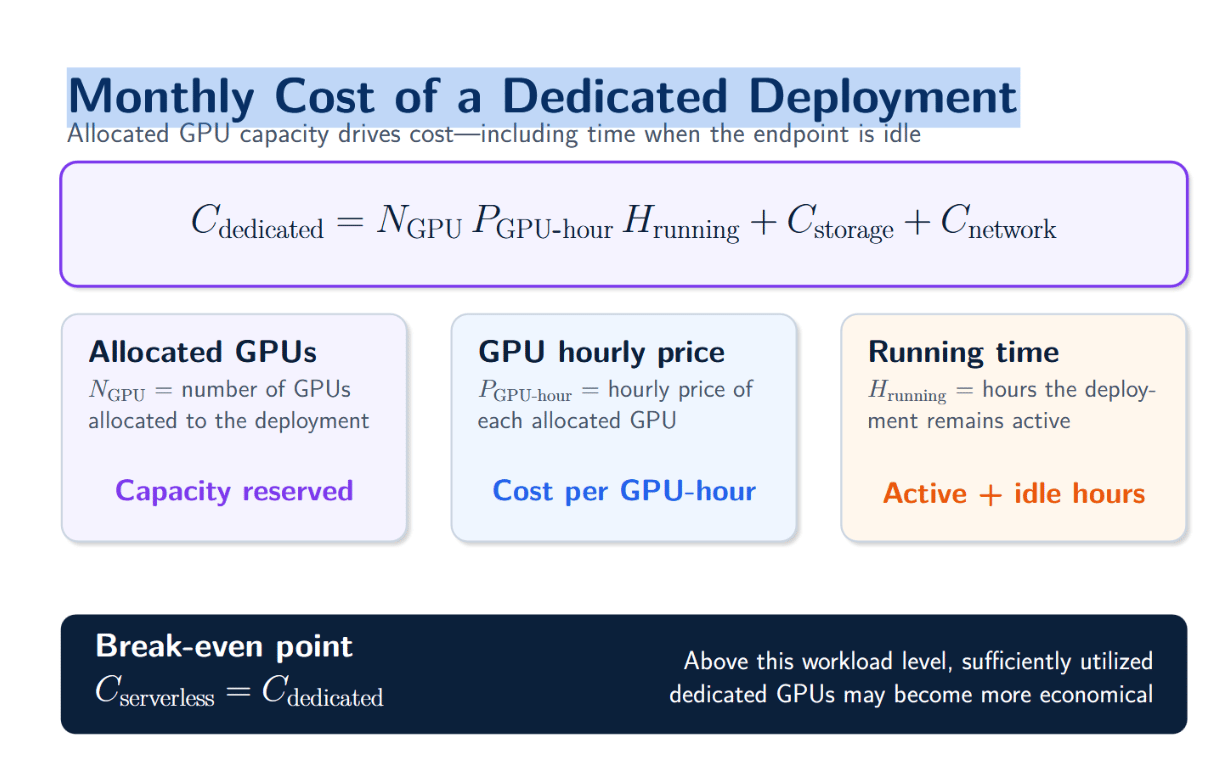
This formula exposes the central difference. Serverless pricing scales most commonly with processed tokens. Dedicated pricing scales with provisioned run time–even when the endpoint isn’t receiving enough traffic to saturate the underlying hardware.
Measure cost per successful task
The break-even calculation above is meaningless if we’re only accounting for tokens or GPU hours. The cheaper endpoint may fail more frequently, cause extra retries, or have too much latency. Instead, we can use a more actionable metric like cost per successfully completed task:
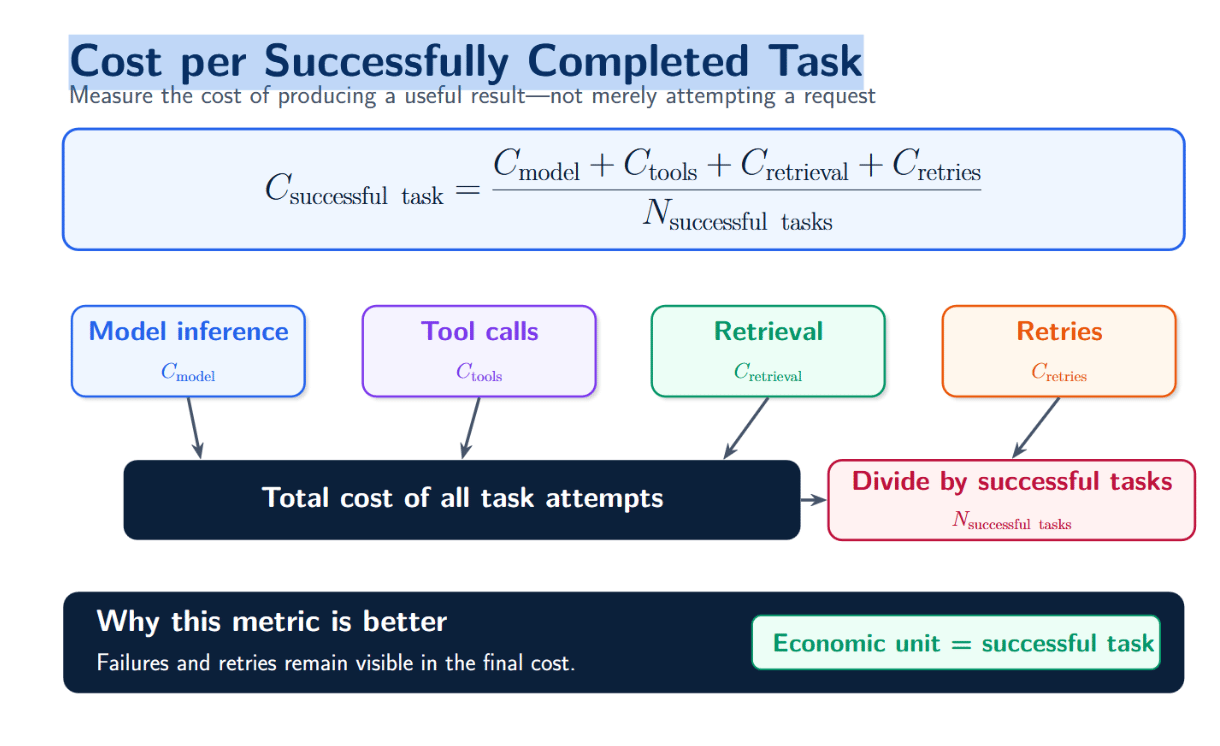
This metric accounts for model inference, tool calls, retrieval, and retries. As such, it measures the cost to generate a useful result rather than simply attempting a request.
It also prevents two common accounting errors. The first is claiming serverless is inexpensive by considering generation tokens, but omitting paid searches, retrievals, reranking, and retries. The second is declaring dedicated inference is inexpensive by dividing by the theoretical maximum throughput rather than the observed successful throughput.
The denominator should include tasks which passed the application’s acceptance criteria. A timeout, an invalid tool call, schema violation, or error by the task-level evaluator all consumed resources but did not produce a successful result.
Traffic shape can invalidate a monthly break-even calculation
Two models might each process 30 million tokens per month, yet require entirely different deployments.
Application A might serve a small number of requests spread throughout the day. Load is fairly constant, and the model remains continuously active. Application B might sit nearly idle for most of the month but run millions of tokens during two daily reporting jobs. Total monthly traffic can be similar, but Application A could achieve decent utilization on reserved capacity. Application B will pay for idle GPUs between bursts unless it can stop or scale the deployment to zero.
To understand your traffic shape, measure:
- Requests per second and per minute
- Peak concurrency
- Median and maximum concurrency
- Input- and output-token distributions
- Percentage of time with zero traffic
- Hourly and daily traffic patterns
- Burst duration
- Queueing time
- Retry frequency
Token volume per month is not sufficient information to select an endpoint. The timing, concentration, and predictability of the workload drive whether serverless or dedicated inference is more economical.
A workload with low average demand and short spikes likely doesn’t map well to continuously provisioned dedicated capacity. One with a predictable baseline could be an excellent match even if it has a lower monthly token total.
Scale-to-zero does not eliminate this trade-off; it shifts it around. Cloud providers like DigitalOcean Dedicated Inference can reduce the desired GPU node count to zero. Pricing models like Together AI let deployments either scale to zero or cease billing when replicas are no longer running. Frameworks like Fireworks allow a zero minimum replicas count, while warning that cold-start times are model size-dependent. Modal defaults functions scaled to zero, but cautions users that initializing large engines may take minutes.
One economic consideration is whether the money saved during idle windows is worth the latency or availability penalty of restoring back up capacity. Interactive services often require a warm minimum replica be maintained. Offline pipelines can typically handle cold starts and should also consider DigitalOcean Batch Inference. This may be more appropriate than either continuously warm endpoints or synchronous serverless requests.
Latency: measure the complete distribution
Dedicated endpoints are sometimes advertised as “faster,” but “faster” is too vague to support a production decision. Look at the full latency distribution instead of a single average.
Measure at least:
- Time to first token
- Inter-token latency
- Output tokens per second
- End-to-end request latency
- Median latency
- P95 and P99 latency
- Queueing time
- Timeout rate
- Cold-start frequency
Dedicated capacity shouldn’t be purchased because the median latency is slightly lower. The bigger benefit is usually control over the slower requests. Reserve headroom and explicit concurrency limits should minimize queueing and help P95 or P99 latency stay predictable.
Let’s say you have a serverless endpoint with a median latency of 1.2 seconds, but a P99 of 12 seconds. If you’re building an interactive agent, that endpoint is likely to provide a worse user experience than a dedicated endpoint with a median of 1.5 seconds but a P99 of 3 seconds. The dedicated endpoint is marginally slower for a typical request but considerably more predictable during the slowest 1% of requests.
This effect is amplified for agentic applications where a single user task may require dozens of sequential model calls. If some calls experience queueing or capacity-related delays, total workflow latency can become unpredictable.
For these reasons, dedicated deployments allow teams to reserve performance headroom and control max concurrency. Dedicated instances are therefore ideal for:
- Voice assistants
- Interactive coding tools
- Real-time recommendation systems
- Multi-step AI agents
- Customer-facing applications with contractual latency targets
- Workloads where slow responses cause abandonment or revenue loss
If you’re doing offline summarization, indexing, evaluation, or document classification, predictable tail latency may be less of a concern than the elasticity and pay-for-use pricing of serverless inference.
How DigitalOcean compares with Together AI, Fireworks AI, and Modal
The providers agree on the fundamental economics more than their product language suggests.
| Provider | Shared or elastic option | Dedicated/custom-model mechanics | Important trade-off |
|---|---|---|---|
| DigitalOcean | Serverless catalog billed by model usage | Supported BYOM models deploy through Dedicated Inference; managed vLLM serving; selectable GPU resources; node count can scale to zero | A direct managed path from catalog inference to private weights, but BYOM formats and architectures must pass compatibility validation |
| Together AI | Serverless models billed per token | Dedicated Model Inference bills per running replica; supported fine-tunes deploy on dedicated endpoints; configurable replica bounds | Strong deployment continuity through compatible APIs, but idle running replicas still bill until scaled down or stopped |
| Fireworks AI | Multi-tenant serverless catalog billed by usage | On-demand deployments use dedicated GPUs and GPU-second billing; uploaded models and LoRA adapters require dedicated deployment | Flexible dedicated deployment and autoscaling controls, with cold-start exposure when minimum replicas are zero |
| Modal | GPU functions and containers can scale to zero with per-second resource billing | Developers package model serving and runtime configuration in code, including vLLM-based services | More runtime flexibility, but the team owns more serving configuration and must manage large-model startup behavior |
DigitalOcean should not claim to have uniquely discovered the serverless-to-dedicated progression. Together and Fireworks make similar high-utilization arguments in their documentation. DigitalOcean’s credible differentiation is the combination of its supported Model Catalog, BYOM workflow, GPU selection, managed vLLM stack, and broader cloud environment for placing inference near application services and data.
A migration rule
Move to dedicated inference only if the desired model doesn’t run with the serverless catalog, if observed utilization lowers the cost per successful task below the serverless price, or if predictable capacity justifies reserved instances’ idle costs. Teams can operationalize that rule via the path below:
- Start with a serverless model while demand and model requirements remain uncertain.
- Measure task success, token distributions, concurrency, P95/P99 latency, retries, and zero-traffic intervals.
- Fine-tune only once you’ve shown that prompting, retrieval, tooling architecture, or model choice can’t achieve the desired level of quality.
- Benchmark candidate custom model against smallest provisioned dedicated endpoint.
- Calculate cost based on observed successful throughput – not the maximum theoretical throughput the provider advertises.
- Send a controlled share of production traffic to the dedicated endpoint.
- Increase replicas only if queue length, tail latencies, and consistent utilization demand it.
- Retain serverless or batch inference for overflow, experiments, rare tasks, or asynchronous work where appropriate.
A hybrid router could send predictable baseline traffic to reserved capacity while sending irregular overflow to an interchangeable serverless model. This may provide tail latency protection without provisioning enough GPUs to meet theoretical peak use for only a few minutes each day. The biggest challenge is consistency of behavior. Various models may generate different structured responses, tool calls, safety decisions, or response quality. The fallback path itself must be tested using the same production suite as the primary deployment.
What teams should stop doing
Teams should stop treating dedicated inference as a maturity badge. Reserving GPUs does not make an AI system production-grade. Measuring whether those GPUs produce reliable, useful work does. They should also stop using the following shortcuts:
- Comparing serverless token prices to dedicated GPU-hours without modeling throughput
- Analyzing monthly token totals without understanding traffic concentration
- Calculating dedicated cost using theoretical instead of actual throughput
- Ignoring failed tasks and paid retries
- Asserting a latency benefit based on median-latency alone
- Believing that scale-to-zero escapes cold-start consequences
- Thinking that BYOM implies any arbitrary architecture or custom kernel is supported
- Moving offline workloads to always-on GPUs without first evaluating a batch API
These mistakes systematically favor overprovisioning. They make dedicated inference appear cheaper on spreadsheets while making it more expensive in production.
Conclusion
The serverless-versus-dedicated decision is not a balanced checklist in which every factor carries equal weight. For most teams, serverless should remain the default until evidence overturns it.
Dedicated inference becomes compelling when the application requires supported private weights, when measured demand keeps the GPU productively occupied, or when predictable P99 latency and reserved capacity are valuable enough to justify idle cost. High monthly token volume, by itself, proves none of those conditions.
DigitalOcean provides a reasonable migration path: start with models served in Serverless Inference, move to BYOM and Dedicated Inference once supported custom weights require specific customization. You can also scale GPU nodes to meet observed demand, and use Batch Inference for qualifying async workloads. Together AI, Fireworks AI, and Modal provide different implementations that broadly fall into the same trade-off/This way, choosing a provider should also weigh factors like model compatibility, cold-start behavior, serving controls, regional placement, and cost per successful task.
The key metric is not advertised price per token or GPU-hour. It’s the cost to produce a successful result at the latency and reliability your application actually requires. Until a team can prove reserved capacity comes out ahead on that basis, switching to dedicated inference is not optimization. It is gambling that future utilization will someday justify today’s idle GPUs.