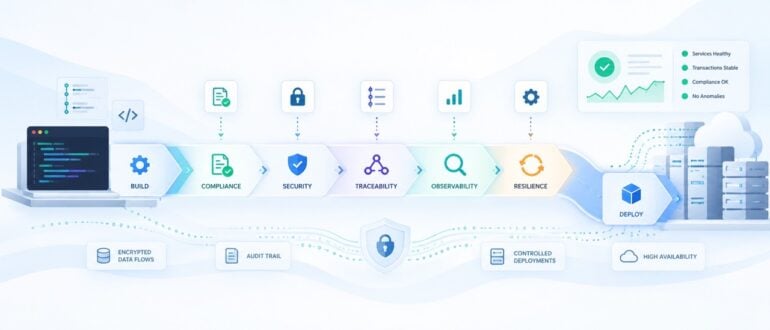

DevOps is often associated with speed: shorter release cycles, greater automation, faster feedback and increased developer autonomy.
In financial services, however, speed is only one part of the equation.
A platform supporting banking, payments or other regulated financial workloads also has to account for security, traceability, resilience, access control and operational risk. A deployment that reaches production quickly but cannot be adequately explained, audited or recovered is not necessarily a successful deployment.
This changes the way DevOps needs to be implemented.
The goal is not to choose between speed and control. The goal is to design delivery systems in which the controls themselves become part of the engineering workflow.
Compliance Should Be Designed Into the Pipeline
One of the easiest mistakes to make in regulated environments is treating compliance as something that happens after engineering work is complete.
A team builds an application, creates its deployment pipeline and then introduces manual approvals or compliance checks immediately before production.
That approach creates friction because governance becomes an external gate.
A stronger model is to move as many controls as possible into the delivery process itself.
Infrastructure policies can be evaluated when infrastructure changes are proposed. Security checks can run automatically during builds. Configuration standards can be validated before deployment. Changes can be associated with version-controlled artifacts and approval records.
This changes compliance from an event into a property of the delivery system.
The objective is straightforward: if an engineer follows the standard deployment path, the resulting workload should already satisfy a large portion of the organization’s technical controls.
Standardization Matters More Than Individual Pipelines
In smaller environments, teams can often maintain their own deployment patterns.
At enterprise scale, particularly within financial institutions, that approach quickly creates operational inconsistency.
Ten application teams can easily produce ten interpretations of how secrets should be managed, how infrastructure should be provisioned, how logging should be configured and how rollback should work.
The solution is not necessarily more documentation.
It is stronger platform engineering.
Reusable infrastructure modules, approved pipeline templates, standardized observability patterns and predefined security controls allow teams to inherit good operational practices rather than recreating them for every application.
The strongest platform teams are not simply providing infrastructure. They are creating paved paths that make the compliant and reliable option the easiest option.
Traceability Becomes an Engineering Requirement
In many DevOps environments, the most important question after a deployment failure is:
What changed?
In regulated financial environments, the questions can go further:
Who initiated the change?
Who approved it?
Which artifact was deployed?
Which infrastructure configuration changed?
What validation occurred before production?
What happened after deployment?
Answering those questions should not require reconstructing activity across several disconnected systems.
Version-controlled infrastructure, immutable build artifacts, centralized deployment records and consistent identity controls create a traceable chain between a proposed change and its production state.
This is useful for governance, but it is equally valuable for engineering.
Good auditability and good incident investigation often depend on the same thing: knowing exactly how the system reached its current state.
Observability Must Include Business Context
Infrastructure monitoring is necessary, but it is not sufficient for critical financial systems.
CPU utilization, memory pressure and error rates can indicate that something is wrong. They do not always indicate whether customers or financial processes are being affected.
Platform teams therefore need to connect technical telemetry with service-level and business-level indicators.
A payment platform, for example, may technically remain available while transaction failures increase. A banking API may respond successfully while latency makes downstream services unusable.
This means observability should evolve beyond infrastructure health toward service health.
Teams need to understand not only whether systems are running, but whether they are producing the expected outcomes.
Reliability Has to Extend Beyond High Availability
Another important distinction is the difference between availability and resilience.
A highly available system is designed to remain accessible despite individual failures.
A resilient system assumes that failures will still occur and asks a different question:
How effectively can the organization detect, contain and recover from them?
That introduces engineering disciplines such as tested rollback procedures, automated recovery where appropriate, dependency mapping, disaster recovery exercises and clearly defined incident ownership.
Recovery plans should also be treated as executable engineering practices rather than static documents.
A recovery procedure that has never been tested is still an assumption.
Developer Experience Still Matters
Regulation can easily create a development environment in which every change requires another ticket, approval or handoff.
That may increase the appearance of control while reducing the effectiveness of engineering teams.
The better approach is to automate controls wherever the risk model allows it and reserve human approval for decisions that genuinely require human judgment.
This creates an important design principle for DevOps teams in financial services:
Governance should reduce uncertainty, not simply add process.
If policy requirements are clear and machine-verifiable, they should ideally be implemented through the platform.
The result is a system where developers can continue moving quickly because the organization has increased engineering discipline rather than increased bureaucracy.
DevOps Maturity Looks Different in Regulated Industries
The most mature DevOps organization is not necessarily the organization that deploys most frequently.
In financial services, maturity is better reflected by the organization’s ability to make changes rapidly and predictably.
Can teams deploy without bypassing security?
Can infrastructure changes be reproduced?
Can incidents be investigated quickly?
Can the organization explain how a production environment reached its current state?
Can services recover when assumptions fail?
Those capabilities require automation, but they also require architecture, operational discipline and thoughtful platform design.
The challenge of DevOps in financial services is therefore not learning how to move slowly because the industry is regulated.
It is learning how to engineer enough confidence into the system that teams can move quickly without losing control.